
When Should You Choose Your Office Furniture?
Before the design is finalised? Before the budget is agreed? Or when you're ready to move in?
The timing of your furniture decisions could have a bigger impact on your workplace investment than you realise.
And no, we're not suggesting you need to choose every chair and table on day one.
But furniture influences far more than the finishing touches. It affects how much space you need, how effectively people work and where your budget is best spent.
So, when should you start?
Ideally, during the initial design stage, while there's still flexibility to explore options, influence layouts and avoid unnecessary costs.
Here are four considerations to help you make smarter furniture decisions and get more from your workplace investment.
1. Don't Start With Products. Start With People.
Headcount doesn't determine how many desks you need. How people use your workplace does.
A business with 100 employees doesn't necessarily need 100 desks. Equally, reducing desk numbers without understanding peak demand can create unnecessary pressure on the space.
A recent space utilisation study we conducted revealed that while 77% of desks were occupied or claimed on average, only 43% had someone physically seated at them. It's a useful reminder that a desk appearing unavailable doesn't necessarily mean it's being actively used.
It's not just about desks. Meeting rooms occupied by individuals taking calls or underused collaboration areas can reveal opportunities to make better use of space through smarter furniture choices and a more effective mix of working settings.
Our advice:
Don't base furniture decisions on headcount or average attendance alone. Through workplace strategy expertise and space utilisation studies, Furniture Studio can help identify what your people genuinely need, reducing unnecessary expenditure and directing investment towards the right furniture solutions.
2. Buying New Isn't Always the Smartest Investment
A new workplace doesn't have to mean an entirely new furniture budget.
Existing desks, chairs and meeting furniture may still have years of useful life ahead. Without an early furniture audit, businesses risk replacing functional pieces and overlooking opportunities to invest their budget more effectively.
At our own Reigate office, we reused more than 70% of our existing furniture, incorporating it into a completely redesigned workplace.
The opportunity isn't simply to spend less. It's to spend more effectively.
Our advice:
Assess what can be retained, refurbished or reconfigured before committing to new purchases. Maximising existing assets can reduce costs and free up budget for improvements that deliver greater value.
3. Think Beyond the Purchase Price
The cheapest furniture today isn't necessarily the most cost-effective over time.
Consider a task chair used for eight hours a day compared with occasional meeting room seating. Their performance, durability and ergonomic requirements are very different, and your investment should reflect that.
For example, a £400 chair lasting eight years costs £50 per year. A £250 chair replaced after three years costs approximately £83 per year, before maintenance or disposal costs.
Warranties, replacement parts, supplier support and lead times also influence long-term value.
Furniture Studio's independent approach allows businesses to compare manufacturers and products based on quality, performance and cost, while coordinating procurement and installation with the wider fit-out programme.
Our advice:
Consider the total cost of ownership, not just the initial price. Prioritise durability where furniture sees the most use and adaptability where workplace requirements may change.
4. Make Your Space Work Harder Through Furniture
Getting more from your workplace doesn't always mean needing more space.
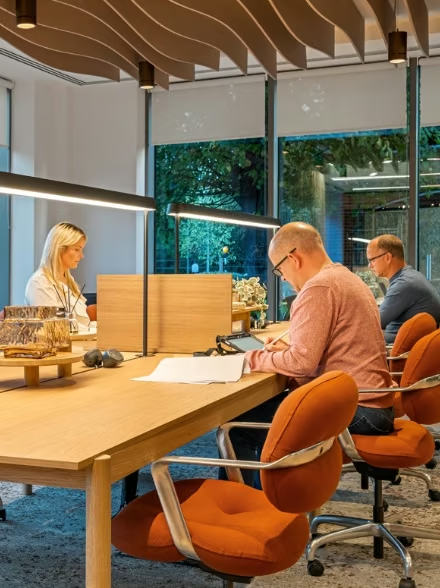
A meeting room with a fixed boardroom table may serve one purpose well, but modular tables and movable furniture could allow the same space to accommodate meetings, workshops, training and collaboration.
Furniture configurations also influence circulation, accessibility and how effectively different working areas connect.
The right choices can increase functionality and help businesses get more from their existing floor space without investing in additional rooms or costly alterations.
Our advice:
Consider how furniture can support multiple activities, not simply whether it fits. Exploring configurations early can improve flexibility, maximise usable space and reduce the need for future changes.
Expert Insight | Hannah Attle, Furniture Studio
“For Forvis Mazars in Manchester, the challenge was to create a workplace that could accommodate a growing team while offering more choice in how people work.
Rather than focusing solely on increasing desk numbers, the design introduced a wider mix of working settings, including focus rooms, collaborative areas and flexible training spaces.
It's a good example of why furniture planning needs to start with understanding how a space will be used. The right mix of settings can support more activities and help businesses get greater value from their workplace investment.”
Your Office Furniture Planning Checklist:
Before committing to your furniture selections, ask yourself:
- Understand your people: Do we know how our workplace is used, including peak occupancy and demand for different settings?
- Review existing assets: What furniture could we retain, repair or reconfigure?
- Consider the layout: Have dimensions, accessibility, circulation and technical requirements informed the design?
- Prioritise investment: Are we spending where furniture will deliver the greatest value?
- Test before committing: Have employees trialled key products for comfort and functionality?
- Plan ahead: Are supplier lead times and installation aligned with the fit-out programme?
- Think long-term: Can our furniture adapt as our business needs change?
If you can't confidently answer these questions, it may be too early to finalise your selections, but it's certainly not too early to start planning.
So, when should you choose your office furniture?
Start planning early, but make your final selections once you understand what your workplace actually needs.
The earlier you involve furniture expertise, the more opportunity you have to explore solutions, maximise existing assets and invest where it will make the greatest difference.
Furniture Studio by Workplace Creations combines independent furniture advice, specialist product knowledge and wider workplace expertise, supporting businesses from initial planning and furniture audits through to selection, procurement and installation.
Whether you're relocating, refurbishing or making better use of your existing space, we're here to help you get more from your workplace and your investment.
Explore Furniture Studio and speak to our team.